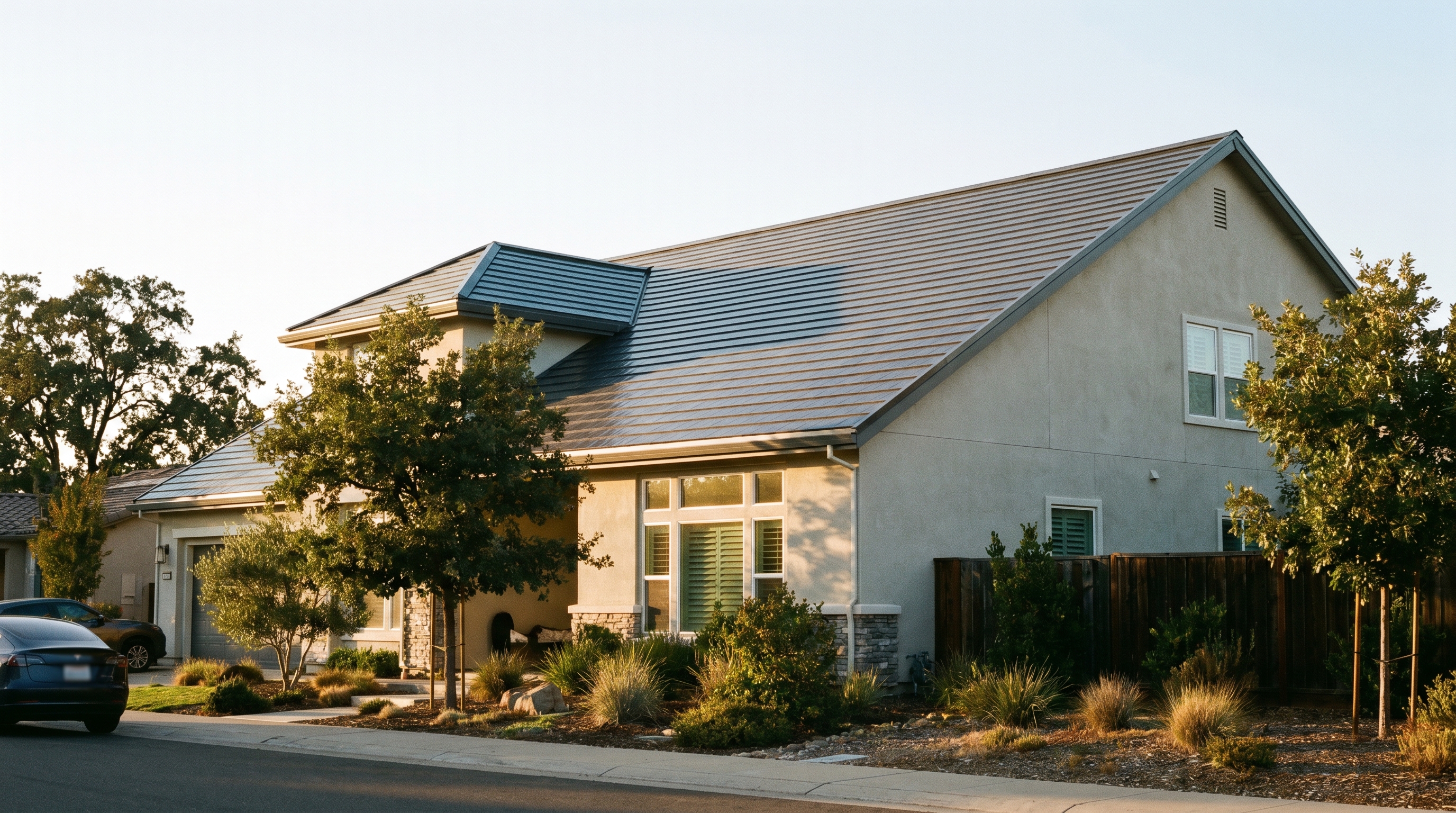
Tesla Solar Roof V3, installed by people who have done it 87 times.
The Tesla Solar Roof V3 is a single integrated tempered-glass shingle field in which active PV tiles and inactive (decorative) tiles are visually indistinguishable. The active tile is a 71.67W monocrystalline-silicon photovoltaic element bonded into a 15" × 45" tempered glass shingle. The inactive tile is the same glass shingle without PV cells. From the street, the field is uniform — a Tesla Solar Roof reads as a single dark textured-glass surface, not as panels.
The inverter is a Tesla Energy Gateway 2, mounted on an exterior wall near the main electrical service. Battery storage is one or more Tesla Powerwall 3 units (13.5 kWh usable per unit). Monitoring is the Tesla app on iOS, Android, and web — production, consumption, battery state-of-charge, grid import/export, and individual circuit-level data are all live.
Priya Achterberg, Helios's co-founder, was on the Tesla Solar Roof launch team at Tesla Energy from 2014 to 2017. She was on the Buffalo plant tour with Elon Musk in 2016. She left Tesla to start Helios because she wanted to install Solar Roof in the Sacramento Valley — Tesla's installer footprint there in 2017 was thin. Helios has installed 87 Tesla Solar Roof systems since 2017. Average system size: 9.4 kWdc. Total Tesla Solar Roof capacity installed by Helios: 818 kWdc.
Tesla Solar Roof is not the right answer for every home. Low-pitch roofs under 4/12 are excluded. Very complex multi-dormer geometry is sometimes better served by GAF Timberline Solar, which can intermix solar shingles with passive Timberline HDZ in a more flexible field. Homes with heavy shading from mature trees that can't be cleared are also poor candidates — the V3 tile string architecture is more sensitive to partial shading than a microinverter-per-shingle system like GAF.
What is in a Tesla Solar Roof.
Manufacturer ........ Tesla, Inc.
Model ............... Solar Roof V3 Textured
Cell technology ..... Monocrystalline silicon PV
Per-tile wattage .... 71.67 W (DC)
Tile dimensions ..... 15" × 45"
Tile material ....... Tempered glass with PV
Weight per tile ..... 13.5 lb
Warranty (tile) ..... 25 years (limited)
Warranty (PV) ....... 25 years (production)
Power inverter ...... Tesla Energy Gateway 2
Inverter warranty ... 12.5 years
Battery storage ..... Tesla Powerwall 3 (13.5 kWh)
Battery warranty .... 10 years
Monitoring .......... Tesla app (iOS / Android / web)
Underlayment ........ Tesla synthetic underlayment
Eave / rake detail .. Tesla integrated metal flashing
Wind rating ......... 130 mph
Hail rating ......... Class 3 (ANSI FM 4473)
What a Tesla Solar Roof actually costs in 2026.
Pricing on a Tesla Solar Roof depends on six variables: roof complexity (number of facets, hips, valleys, dormers), pitch, square footage of the active field, the number of Powerwall 3 batteries specified, whether your existing main panel needs to be upgraded for the new service, and PG&E interconnection fees. Tesla's published "from $40K" pricing assumes a small home with minimal complexity and no battery. Real-world Sacramento-Valley installs almost never come in that low.
Helios models every Tesla Solar Roof project in HelioScope (PV-modeling SaaS) before quoting. The site audit gives us the panel-direction data, the shading profile, the roof geometry, and the homeowner's last twelve months of PG&E usage. The HelioScope model produces a year-1 production estimate accurate to within roughly ±5%.
The following ranges are real Helios install pricing in 2026 dollars, before federal Section 25D residential clean energy credit (the 30% ITC).
All prices include tear-off of existing asphalt, full Tesla Solar Roof installation, Tesla Energy Gateway 2, specified Powerwall 3 storage, PG&E interconnection paperwork, and permit. Federal Section 25D ITC (30%) typically reduces final cost by $22,000 – $64,000 depending on system size. California has no state solar tax credit as of 2026.
An eight-day install, beginning to end.
Once permits are pulled and materials are on-site, a typical Tesla Solar Roof installation by Helios is eight working days. We do not subcontract any of this work — every Helios install is foremaned by Theo Ramaswamy, crew lead Marcus Delgado, or crew lead Hana Park.
Site protection + scaffold install
Day 1. Driveway dumpster delivered. Landscape and pool protection installed. Perimeter scaffold up. Tile delivery scheduled for Day 2 morning.
Typical: 1 dayTear-off existing roofing
Day 2. Full tear-off of existing asphalt or tile down to deck. Deck inspection. Replace any rotted deck boards. Felt paper and Tesla synthetic underlayment installed same day.
Typical: 1 dayEave + rake + valley flashing
Day 3. Tesla integrated metal eave flashing, rake flashing, and valley flashing installed. Penetration boots set for vents and stack pipes.
Typical: 1 dayActive + inactive tile install
Days 4–6. The tile field goes on three days. Active PV tiles are wired in series within each string as they are placed. Inactive tiles fill non-PV areas of the field.
Typical: 3 daysEnergy Gateway + Powerwall install
Day 7. Tesla Energy Gateway 2 mounted near main service panel. Powerwall 3 units mounted on exterior wall. DC and AC conduit run.
Typical: 1 dayFinal commissioning + walkthrough
Day 8. System commissioned in test mode. Tesla app activated for homeowner. Walkthrough of monitoring, Backup Mode, charging profiles. Site cleanup. Scaffold pulled down.
Typical: 1 dayWhat a Helios Tesla Solar Roof in El Dorado Hills actually produces.
The following is a real Helios install with year-1 monitoring data shared by the homeowner with written consent. No estimates. No marketing-grade calculator output. The numbers below are pulled from the Tesla monitoring portal.
Jul 2024 ............ 1,612 kWh
Aug 2024 ............ 1,548 kWh
Sep 2024 ............ 1,322 kWh
Oct 2024 ............ 1,067 kWh
Nov 2024 ............   768 kWh
Dec 2024 ............   612 kWh
Jan 2025 ............   698 kWh
Feb 2025 ............   894 kWh
Mar 2025 ............ 1,202 kWh
Apr 2025 ............ 1,488 kWh
May 2025 ............ 1,664 kWh
Jun 2025 ............ 1,708 kWh
─── TOTAL Y1 ........ 14,583 kWh
Tesla Solar Roof, the eight questions homeowners ask first.
Can you put a Tesla Solar Roof on any house?
Most homes work. Tesla Solar Roof requires a minimum 4/12 pitch, structural review of the roof framing, and roof geometry simple enough to be tiled cleanly. Very complex multi-dormer or low-pitch roofs are sometimes better candidates for GAF Timberline Solar. The site audit is where this gets sorted.
How does a Tesla Solar Roof compare visually to a regular roof?
From the street it reads as a single uniform dark textured-glass field. The V3 textured tile has subtle horizontal banding that catches light. There are no visible panels, no rails, no junction boxes on the field. The eave drip-edge and ridge cap are integrated metal flashing in matching matte black.
What happens if a tile breaks?
Tesla replaces broken tiles under the 25-year limited warranty. Helios handles the replacement install for the homeowner; the part is shipped from Tesla's Lathrop CA distribution center, typically within 7–14 days. Active PV tiles are replaced like-for-like; inactive tiles are replaced with the same product line.
Does Tesla still make the Solar Roof?
Yes. The V3 Textured tile is in active production at Tesla's Buffalo facility. Tesla has scaled back direct-to-consumer Solar Roof sales since 2023 but continues to manufacture and supply certified installers like Helios. We have a current supply agreement with Tesla and have not had a sustained supply disruption since 2022.
What does the warranty actually cover?
The Tesla Solar Roof has three concurrent 25-year warranties: the tile itself (against defects and water intrusion), the PV power output (84.8% of nameplate at year 25), and the wind/weatherproofing performance of the field as a single system. The Tesla Energy Gateway 2 carries a 12.5-year warranty. The Powerwall 3 carries a 10-year warranty. Helios warranties our installation labor for 25 years.
Will the Solar Roof work in a power outage?
With Powerwall 3 installed, yes. The system enters Backup Mode automatically when the grid goes down. The Powerwall continues to power your home from stored solar energy; the Solar Roof itself continues to produce in daylight hours, recharging the Powerwall. PG&E PSPS (Public Safety Power Shutoff) events are the most common outage scenario in our service area; a 2× Powerwall 3 install typically rides through a 2-day PSPS with normal household consumption.
How is this different from regular solar panels on an asphalt shingle roof?
Bolt-on rack-and-rail solar is panels mounted on stanchions that penetrate your existing roof. The roof and the solar are separate systems with separate warranties from separate companies. Tesla Solar Roof is a single integrated system — the roof IS the solar. One warranty, one installation, one visual surface. We wrote a whole homepage section on this.
What is the interconnection timeline with PG&E?
PG&E NEM 3.0 interconnection typically takes 3–8 weeks from witness inspection to Permission To Operate. Helios's two permit-and-interconnection specialists handle all PG&E paperwork. The system is fully installed and commissioned during this window; it just isn't authorized to export to grid until PTO.
"I was on the Solar Roof launch team at Tesla Energy in 2016. I have installed eighty-seven of them at Helios since 2017. There is no installer in Northern California who has done more."
— PRIYA ACHTERBERG · CO-FOUNDERRequest a Tesla Solar Roof site audit.
Ninety minutes on-site. Three quotes — Tesla, GAF, SunStyle — emailed within five business days. No cost. No high-pressure follow-up.