PG&E NEM 3.0 and why every Helios quote includes battery storage.
This is the most important California solar policy question of 2026, and most California solar installer websites do not address it. We do. If you are evaluating a residential solar installation in PG&E territory and the installer's quote does not include battery storage, ask why. Under NEM 3.0, a solar-only install (no battery) produces a meaningfully worse internal rate of return than a solar-plus-storage install. The math has shifted. The product has shifted with it.
What NEM 2.0 was, and why it worked
Net Energy Metering 2.0 was the California residential solar billing structure from 2016 to April 2023. Under NEM 2.0, every kilowatt-hour your solar system exported to the grid was credited to your PG&E account at the same retail rate you paid for kilowatt-hours you imported. In the Sacramento Valley peak season, that retail rate is approximately $0.43/kWh for the top tier on the E-TOU-C residential time-of-use schedule.
Under that structure, a solar system that exported 5,000 kWh per year to the grid generated approximately $2,150 in retail-rate credits. Add the consumption offset on the kWh you used directly, and a typical 8 kWdc Sacramento Valley install paid back in 6–8 years. Solar-only was a great financial product. Battery storage was a premium upsell, not a requirement.
What changed in April 2023
The California Public Utilities Commission adopted a successor tariff called the Net Billing Tariff — commonly referred to as NEM 3.0 — effective for new solar interconnections submitted on or after April 15, 2023. The change was substantial:
Under NEM 3.0, exports to grid are no longer credited at the retail rate. They are credited at an avoided-cost rate — what it would have cost the utility to procure that energy on the wholesale market. The avoided-cost rate is published by the CPUC as a 24-hour, 365-day matrix of hourly rates. The annual average export rate for residential PG&E customers is approximately $0.08/kWh — roughly an 81% reduction from NEM 2.0's $0.43.
Why this killed the export-everything model
Under NEM 3.0, exporting a kWh to the grid is no longer a near-break-even economic event. It is a substantial loss. The same kWh, if used inside your home during a high-rate window, would offset retail consumption at $0.43. The same kWh, if exported, returns only $0.08. That is a $0.35/kWh wedge.
The economic analysis of a solar-only system has flipped. Consider a 10 kWdc Sacramento Valley install producing approximately 15,000 kWh/yr, with a homeowner using approximately 12,000 kWh/yr inside the home:
                            NEM 2.0           NEM 3.0
Self-consumed (12,000 kWh) · $5,160/yr ........ $5,160/yr
Exported (3,000 kWh) ······· $1,290/yr ........ $240/yr
TOTAL ANNUAL VALUE ········· $6,450/yr ........ $5,400/yr
                              (-16%)
PAYBACK PERIOD ············· 6.5 years ........ 9.2 years
Solar-only still pencils. It just pencils worse. The 16% annual revenue reduction and the 2.7-year payback extension are the entire reason the California residential solar market shifted toward battery storage in 2023.
Why battery storage is now the answer, not the upsell
If exports are credited at $0.08 but self-consumed kWh offset retail rates at $0.43, the rational response is to not export. Battery storage makes that possible. The logic is:
Your solar system produces approximately 10–15% more during solar noon (when retail rates are mid-tier) than your home consumes at that moment. Without a battery, that excess production exports to grid at $0.08. With a battery, that excess production charges the battery instead. Then in the 4pm–9pm window — when retail rates jump to $0.55+/kWh on E-TOU-C peak — the battery discharges to power your home. You self-consume the same kWh during a higher-rate window.
This is the peak-shift arbitrage. The kWh is worth $0.08 at noon if exported. It is worth $0.55 at 6pm if discharged from a battery. The battery is the time-shift device that captures the wedge.
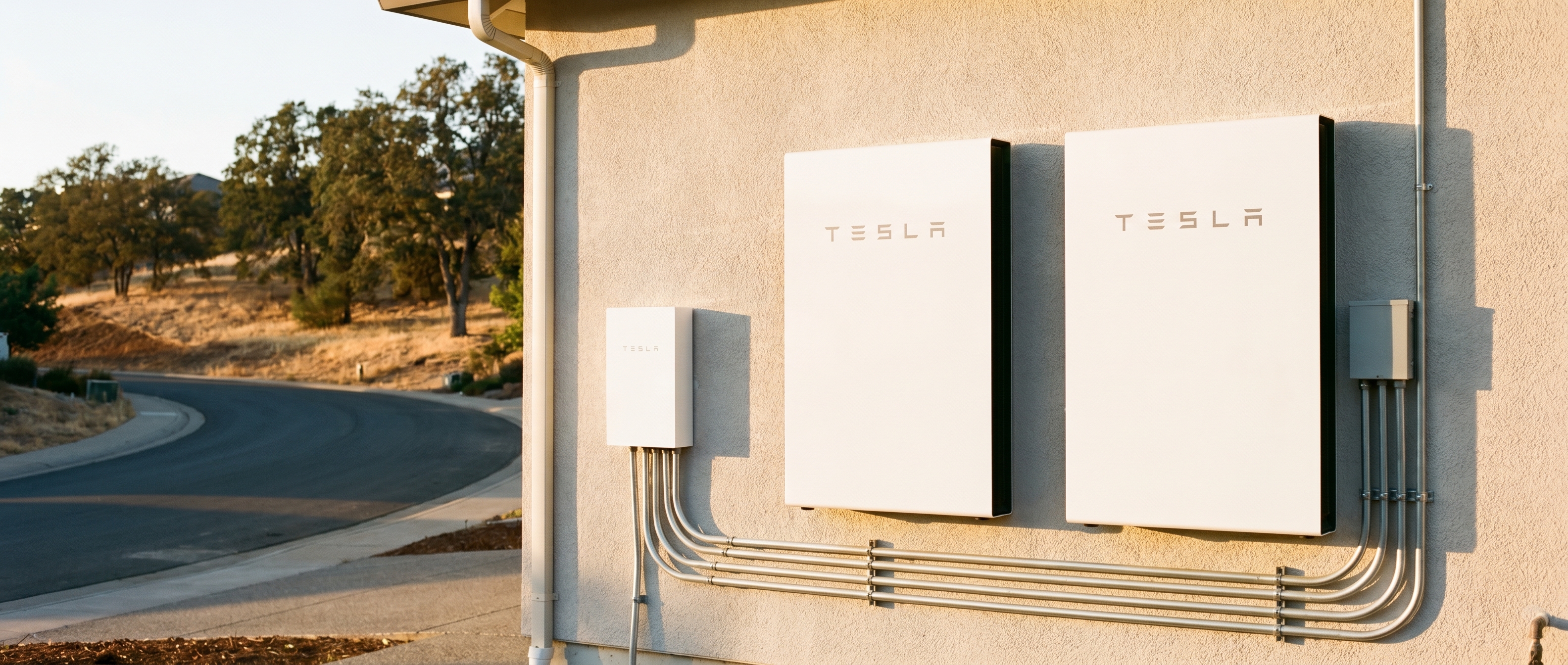
Every Helios quote since May 2023 has included at least 13.5 kWh of battery storage — one Tesla Powerwall 3 or equivalent. For homes with larger consumption, we typically recommend 2× or 3× Powerwall 3. This is not an upsell. It is the only configuration that makes a 2026 California solar installation produce a reasonable internal rate of return.
How much battery storage does a 2026 California install actually need?
The sizing logic is straightforward: enough battery capacity to time-shift the excess solar production into the 4pm–9pm peak window. Most Sacramento Valley homes consume 12–18 kWh during the 5-hour evening peak. 13.5 kWh of usable battery capacity (one Powerwall 3) covers most of that window for a typical install.
HOME PROFILE                          RECOMMENDED BATTERY
Small home, low evening usage ······· 1× Powerwall 3 (13.5 kWh)
Medium home, average usage ·········· 2× Powerwall 3 (27 kWh)
Large home, EV charging, AC heavy ··· 3× Powerwall 3 (40.5 kWh)
Large home, all-electric, EV+pool ··· 4× Powerwall 3 (54 kWh)
The site audit captures your last 12 months of hourly PG&E usage. We size the battery to cover your specific peak-hour consumption profile, not a generic recommendation.
What battery storage does in a power outage
The secondary benefit of battery storage is backup. PG&E's Public Safety Power Shutoff (PSPS) program — driven by wildfire risk — caused multi-day outages across our service area in 2019, 2020, 2021, and 2023. A 2× Powerwall 3 install typically rides through a 2-day PSPS with normal household consumption.
Tesla Powerwall 3 supports whole-home backup when paired with a Tesla Backup Gateway 2 — every circuit in the home stays live during an outage. The alternative is partial-home backup, where only critical circuits (refrigerator, well pump, internet, a few outlets) stay live; partial-home is less expensive and is the right answer for homeowners who run electric resistance heat or central air conditioning that would drain the battery in hours.
Will NEM 3.0 change again?
Probably, eventually, in some form. California utility-rate structures are reviewed every 3–5 years through the CPUC rate-case process. A return to NEM 2.0-style retail-rate export crediting is unlikely — the political pressure that drove the 2023 change (rate-payer subsidy concerns, the "cost shift" debate, utility lobbying) has not gone away. But further changes to the avoided-cost rate matrix, the demand-charge structure for solar-plus-storage homes, or the time-of-use windows are all on the table.
Helios does not pretend to know what 2028's tariff will look like. We do know that a solar-plus-storage install is robust across a wider range of future tariff structures than a solar-only install. Battery storage gives you optionality. Solar-only without storage commits you to whatever the future export rate happens to be.
We model NEM 3.0 economics into every site audit.
The 3-quote PDF includes year-1 production, year-1 self-consumption, year-1 export, NEM 3.0 export credit, and net PG&E bill projection — separately for each of the three integrated systems.